 explore the guide ship original artwork safely - Art data and analysis" width="1200" height="420" style="width:100%;max-height:420px;object-fit:cover;margin-bottom:24px;" loading="eager" fetchpriority="high" decoding="async">
Optimized Article:
How to Ship Original Artwork Safely
Shipping original artwork safely is a core skill for artists turning creative work into reliable income. Online art sales reached $10.5 billion globally in 2024, representing 18% of total sales (Art Basel & UBS, 2025). In the US, the online art sales industry generated $5.9 billion in 2025, while the broader arts and culture sector added $1.17 trillion to GDP in 2023 (Bureau of Economic Analysis, 2026).
For Broward County artists, these numbers are more than statistics. The local nonprofit arts economy generated $386.6 million in activity and supported 6,718 jobs in FY2022 (Americans for the Arts, 2023). Whether you're a painter who started in Fort Lauderdale art classes for adults or an established creator fulfilling commissions, one damaged shipment can erase weeks of studio time and damage client trust.
Baseline reality: Custom oil portrait commissions range from under $200 to over $10,000. The median wage for craft and fine artists sits at $56,260 annually (Bureau of Labor Statistics, 2025). A single preventable loss hurts.
How to Pack Paintings for Shipping: Medium-Specific Techniques
Optimization path begins with understanding material behavior. Acrylic paints accounted for 32% of global art paint unit volume in 2024, while oil paints accounted for 18% (Art Basel & UBS). Both require different handling during transit.
For impasto and alla prima work, leave clearance between the paint surface and any packing material. Thick texture can be flattened under pressure. Oil paintings must be fully cured before shipping - rushing this step risks smudges and transfer.
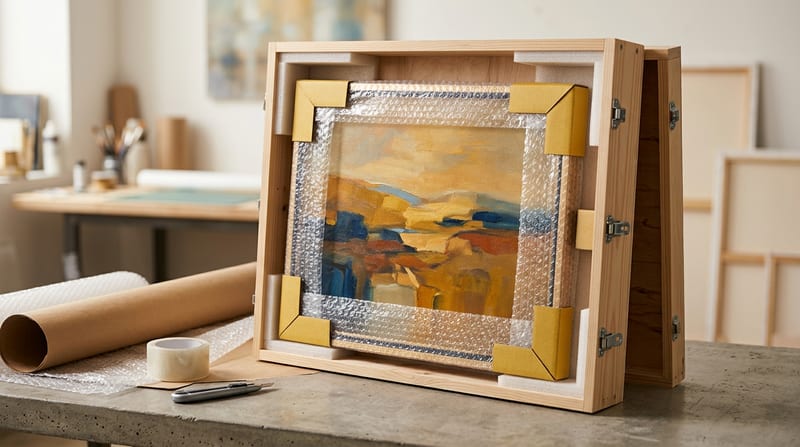
Practical packing sequence:
- Apply glassine paper (never plastic directly on paint)
- Add rigid corner protectors
- Place foam board or cardboard on both front and back
- Double-box with minimum 3 inches of cushioning between boxes
- Label clearly with “Fragile,” “This Side Up,” and directional arrows
Works on paper require acid-free tissue and rigid mailers. Never roll watercolors showing any buckling. For framed pieces behind glass, apply painter’s tape in an X pattern to contain potential shards.
Three-dimensional work demands custom foam inserts. Fill every void. Movement inside the box is the leading cause of breakage in ceramics and mixed media.
Choosing the Right Carrier for Original Artwork
Standard carriers (UPS, FedEx, USPS) work for pieces under $5,000 declared value. FedEx generally handles oversized crates better. UPS offers more reliable pickup windows. USPS is cheapest but slowest for claims.
Specialty fine art shippers become necessary above $5,000 or for irreplaceable work. Masterpak, Craters and Freighters, and similar services provide climate-controlled, white-glove handling. Galleries under $250K turnover saw 17% sales growth in 2025 despite a cooling market (Artsy Editorial Team), meaning more small studios are shipping directly.
International shipments require provenance documentation, certificate of authenticity, and proper commercial invoices. Keep copies in waterproof packaging.
Documenting Artwork Before Shipping
A professional condition report is non-negotiable. Document surface condition, existing flaws, frame stability, and hardware before the piece leaves your studio. Galleries require them. So should you.
Photography protocol for claims:
- Minimum 300 DPI
- Use raking light to capture impasto texture
- Shoot front, back, edges, and key details
See our guide: How to Photograph Artwork for Selling: Pro Guide.
Median annual wage for arts and design occupations reached $53,180 in May 2024 with 84,900 projected annual job openings (Bureau of Labor Statistics, 2025). Protecting finished work directly protects earning potential.
Cost Planning and Insurance for 2026
Small works under 24 inches typically cost $25 - $75 to ship. Medium pieces (24 - 48 inches) run $75 - $200. Oversized or high-value work quickly reaches $300 - $2,000 with specialty carriers.
Shipping insurance usually costs 1 - 3% of declared value. This is far more affordable than the 5 - 10% annual cost of storing and insuring a collection. Build shipping and crating into your pricing from the first client conversation.
Failure mode check: Underinsuring or using non-archival materials (newspaper, regular bubble wrap, acidic tissue) creates permanent damage. Heat softens oil paint. Cold makes canvas brittle. Humidity warps paper. These risks are predictable and preventable.
Action Checklist: Ship Original Artwork Safely
- Create and photograph a condition report
- Use archival materials only (glassine, acid-free tissue, proper cushioning)
- Double-box with adequate clearance for textured surfaces
- Select carrier based on value and distance
- Include full provenance and authenticity documents for international moves
- Send tracking and unboxing instructions to the buyer
- Require buyer to document arrival condition immediately
The optimization path is clear. Artists who treat shipping as a professional system - not an afterthought - reduce damage claims dramatically and build stronger collector relationships. In a market where the US represents 43% of global art sales (Art Basel & UBS, 2025) and Broward supports thousands of arts jobs, execution at every step separates hobbyists from sustainable careers.
Implement this process on your next shipment. Document results, and Refine. The difference between $50 and $300 monthly earnings often comes down to operational details like these.
Sources cited: Art Basel & UBS, Bureau of Economic Analysis, Bureau of Labor Statistics (multiple reports), Americans for the Arts (Broward AEP6), National Endowment for the Arts, Broward Cultural Division, UBS Global Art Market Research, and additional authoritative references from the Broward arts economic data portal.